Understanding the Relationship Between Interest Rates and Bond Prices
Bond prices may seem stable, but they react quickly to changes in interest rates—demonstrating how interest rates impact bond prices. This relationship is central to fixed income investing and highlights the importance of understanding interest rate risk and inflation. Once you grasp this concept, many other aspects of bond investing become clearer.
The Link Between Interest Rates and Bond Prices
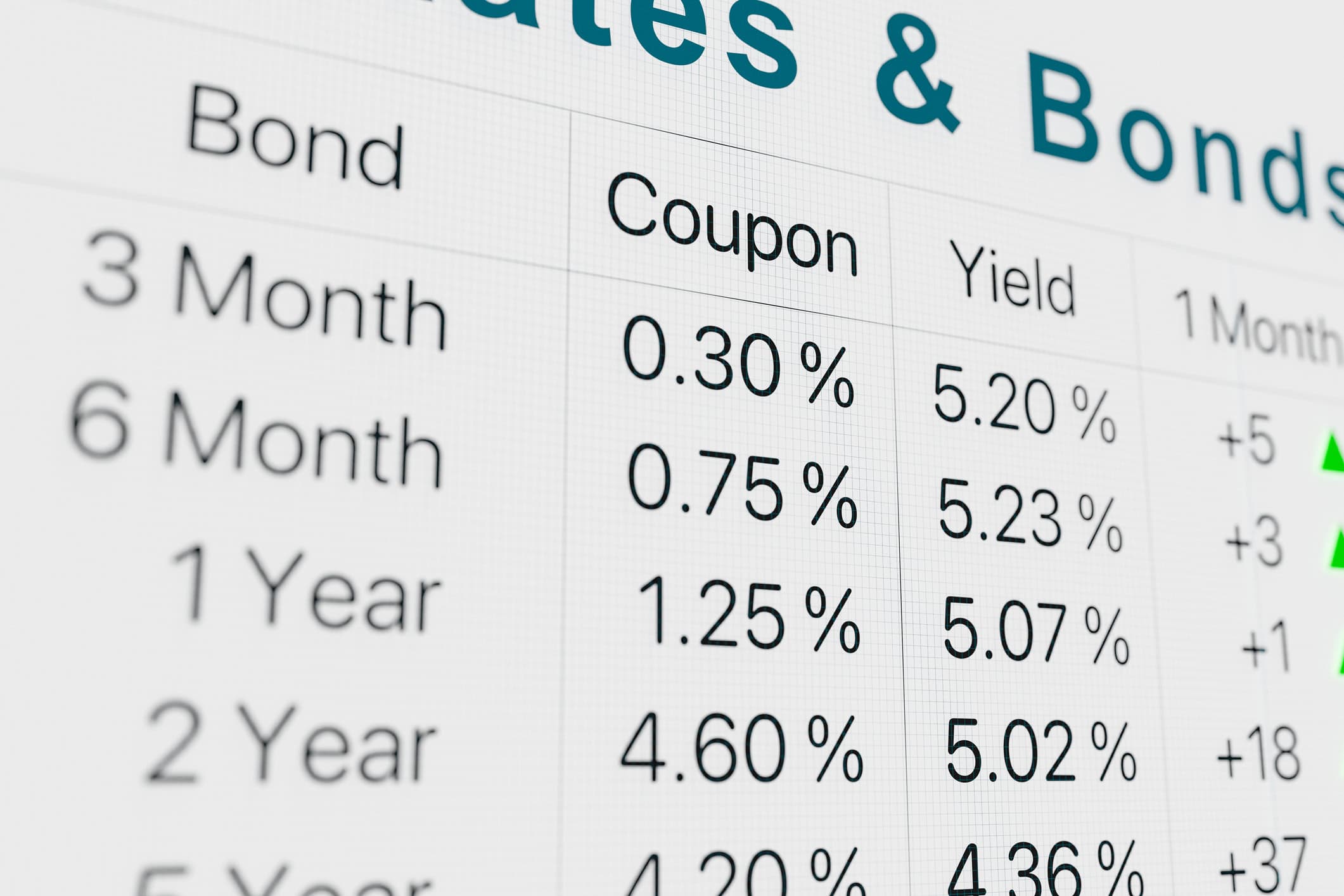
A bond pays fixed coupon payments and returns principal at maturity. While these cash flows remain constant, the rate investors demand for new investments can change. When new bonds offer higher yields, existing bonds with lower coupons become less attractive, causing their prices to drop. Conversely, when market rates decline, older bonds with higher coupons become more valuable, and their prices rise. This inverse relationship is the foundation of bond pricing:
- Rates rise, prices fall
- Rates fall, prices rise
- Longer maturities move more
- Lower coupons mean greater sensitivity
- Zero-coupon bonds are most reactive
Why Bond Prices Change When Yields Move
If a bond pays a 3% coupon and new bonds offer 5%, investors will only buy the older bond at a discount. If a bond pays 5% and new bonds offer 3%, the older bond may trade at a premium. This adjustment is based on discounting future cash flows: higher market rates lower present values, while lower rates increase them.
| Existing Coupon | New Rate | Price Effect | Trading Level |
|---|---|---|---|
| 3% | 5% | Price falls | Discount |
| 5% | 3% | Price rises | Premium |
| 4% | 4% | Little change | Near par |
A bond doesn’t become “bad” if rates rise; its payments remain the same if the issuer is creditworthy. What changes is the price someone will pay today.
Duration and Maturity in Bond Price Sensitivity
Not all bonds react equally to rate changes. Maturity is one factor: a bond maturing in two years is less exposed to rate changes than one maturing in twenty years. Longer-term bonds have more value tied to distant cash flows, making them more sensitive to discount rate changes.
Duration is a more refined measure of interest rate risk. It estimates how much a bond’s price will change for a given move in rates. A higher duration means greater price sensitivity.
- Maturity: Principal repayment date
- Duration: Price sensitivity to rate changes
- Modified duration: Estimated % price change for a 1% rate move
For example, a bond fund with a duration of 6 would see a roughly 6% price decline if rates rise by 1%. Long duration can be uncomfortable during rate hikes but rewarding when rates fall.
Coupon Rates, Yield to Maturity, and Bond Pricing
Coupon rate and yield are often confused. The coupon rate is the bond’s stated annual interest as a percentage of face value. Yield is the return based on the bond’s current market price. For example, a $1,000 bond with a 4% coupon pays $40 per year. If it trades at $900, the yield for a new buyer is higher than 4%.
Yield to maturity (YTM) estimates the total annualized return if the bond is held to maturity, including coupon income, any premium or discount, and time until maturity. Bond prices and yields move in opposite directions: a bond above face value has a lower yield than its coupon, while a bond below face value has a higher yield.
Why Lower-Coupon Bonds Move More
Higher-coupon bonds return more money earlier, making them less sensitive to rate changes. Lower-coupon bonds have more value tied to the final payment, increasing duration and price swings. Zero-coupon bonds, with all value at maturity, are especially reactive to rate changes.
What Rising Interest Rates Mean for Investors
Rising rates can be frustrating as bond prices fall. However, higher rates create opportunities: new bonds offer better yields, and reinvested coupons or maturing principal can earn more. Over time, higher income can offset earlier price declines, especially for patient investors.
Short-term market value and long-term income are not the same. Investors planning to sell soon care more about price volatility, while those holding to maturity focus on issuer quality and cash flow.
How Falling Interest Rates Affect Bonds
When rates decline, bond prices rise, creating strong total returns—especially for long-duration bonds and bond funds. However, falling rates mean lower yields on new bonds, making reinvestment less attractive.
Interest Rate Risk: Bond Funds vs. Individual Bonds
Interest rate risk appears differently depending on how you invest. An individual bond held to maturity has a known end date and face value (assuming no default). Price drops from rising rates may not matter if you hold to maturity. Bond funds, however, don’t mature on a single date; their net asset value reflects current market prices, making rate moves more visible.
- Individual bonds: Predictable maturity, known face value, direct cash flow
- Bond funds: Broad diversification, ongoing market pricing
- Short-duration funds: Lower rate sensitivity, lower yield
- Long-duration funds: Higher rate sensitivity, greater upside when yields fall
The best fit depends on your time horizon, income needs, and tolerance for price movement.
Practical Ways to Respond to Interest Rate Changes
Trying to predict every rate move is rarely successful. A steadier approach is to build a portfolio that functions across environments:
- Match duration to your timeline: Shorter duration for near-term needs
- Use reinvestment: Rising rates can improve future income
- Focus on total return: Income matters over multi-year periods
- Distinguish rate risk from credit risk: A bond can fall in price due to rising yields even if the issuer is sound
For many investors, the key is to ask not whether rate moves are “good” or “bad,” but which bonds, over what time period, and for what purpose. This leads to clearer decisions and a stronger bond strategy.
Disclosures:
This commentary is not a recommendation to buy or sell a specific security. The content is not intended to be legal, tax or financial advice. Please consult a legal, tax or financial professional for information specific to your individual situation. Investing involves risk, including possible loss of principal. Past performance is no guarantee of future results. Diversification does not guarantee a profit or protect against loss. The interest on municipal bonds, unless identified as “taxable” or “AMT” (alternative minimum tax), is exempt from federal income tax, but may be subject to local or state income tax for residents of certain states.