How Interest Rates Impact Bond Prices Explained
Bond prices often look calm on the surface, yet they respond quickly when interest rates shift, illustrating how interest rates impact bond prices. That reaction is one of the central ideas in fixed income investing, and it highlights the importance of understanding interest rate risk and inflation; once it clicks, many other bond concepts start to make sense.
The short version is simple: when interest rates rise, existing bond prices usually fall. When interest rates fall, existing bond prices usually rise. The reason is not mystery or market drama. It is math, competition, and the value of future cash flows.
The basic link between interest rates and bond prices
A bond is a contract that pays a stream of cash flows, usually fixed coupon payments plus the return of the full face value at maturity or at a previously stated, optional, early call date. Those cash flows do not change just because the market changes. What changes is the rate investors demand on new money.
If new bonds start offering higher yields, older bonds with lower coupons become less attractive. Their prices must drop until their return is competitive with newly issued bonds. The reverse happens when market rates decline. Older bonds with higher coupons become more valuable, so their prices rise.
That inverse relationship is the foundation of bond pricing.
After that core idea, most of the finer points fall into place:
- Rates rise, prices fall
- Rates fall, prices rise
- Longer maturities tend to move more
- Lower coupons usually mean greater sensitivity
- Zero-coupon bonds are often the most reactive
Why bond prices change when market yields move
Take a simple example. Suppose a bond pays a 3% coupon, and similar new bonds are now issued at 5%. Few investors would want the older 3% bond at full price when a better yield is available elsewhere. So the older bond must trade at a discount. That discount boosts its effective return for a new buyer.
The same logic works in reverse. If a bond pays 5% and new bonds offer only 3%, the older bond becomes appealing. Investors may be willing to pay more than face value, pushing it to a premium.
This adjustment happens because bond pricing is based on discounting future cash flows. The higher the market rate used to discount those cash flows, the lower the present value. Lower discount rates produce higher present values.
Here is a simple way to visualize it:
| Existing Bond Coupon | New Market Rate | Likely Bond Price Effect | Trading Level |
| 3% | 5% | Price falls | Discount |
| 5% | 3% | Price rises | Premium |
| 4% | 4% | Little change | Near par |
A bond does not become “bad” just because rates rise. Its promised payments are still the same if the issuer remains creditworthy. What changes is the price someone is willing to pay for those payments today.
Duration and maturity in bond price sensitivity
Not all bonds react with the same intensity. Some barely budge. Others can move in a way that surprises investors who assumed bonds always stay steady.
Maturity is one reason. A bond maturing in two years has much less time exposed to changing market rates than a bond maturing in twenty years. With a long-term bond, a larger share of value sits far in the future, and far-off cash flows are more sensitive to changes in discount rates.
Duration gives a more refined measure, specifically in assessing interest rate risk. It estimates how much a bond’s price is likely to change when interest rates move by a given amount, illustrating how interest rates impact bond prices. A bond with a higher duration generally has greater price sensitivity than one with a lower duration.
The key terms are easier to keep straight when viewed side by side:
- Maturity: The date when the principal is repaid
- Duration: A measure of price sensitivity to interest rate changes
- Modified duration: An estimate of percentage price change for a 1% move in rates
- Convexity: The way price sensitivity itself shifts as yields move
A practical example helps. If a bond fund has a duration of 6, a 1% rise in rates would imply roughly a 6% price decline, all else equal. That is an estimate, not a guarantee, though it is a useful starting point.
Long duration can feel uncomfortable during rate hikes due to inflation. It can also be rewarding when rates fall.
Coupon rates, yield to maturity, and bond pricing terms
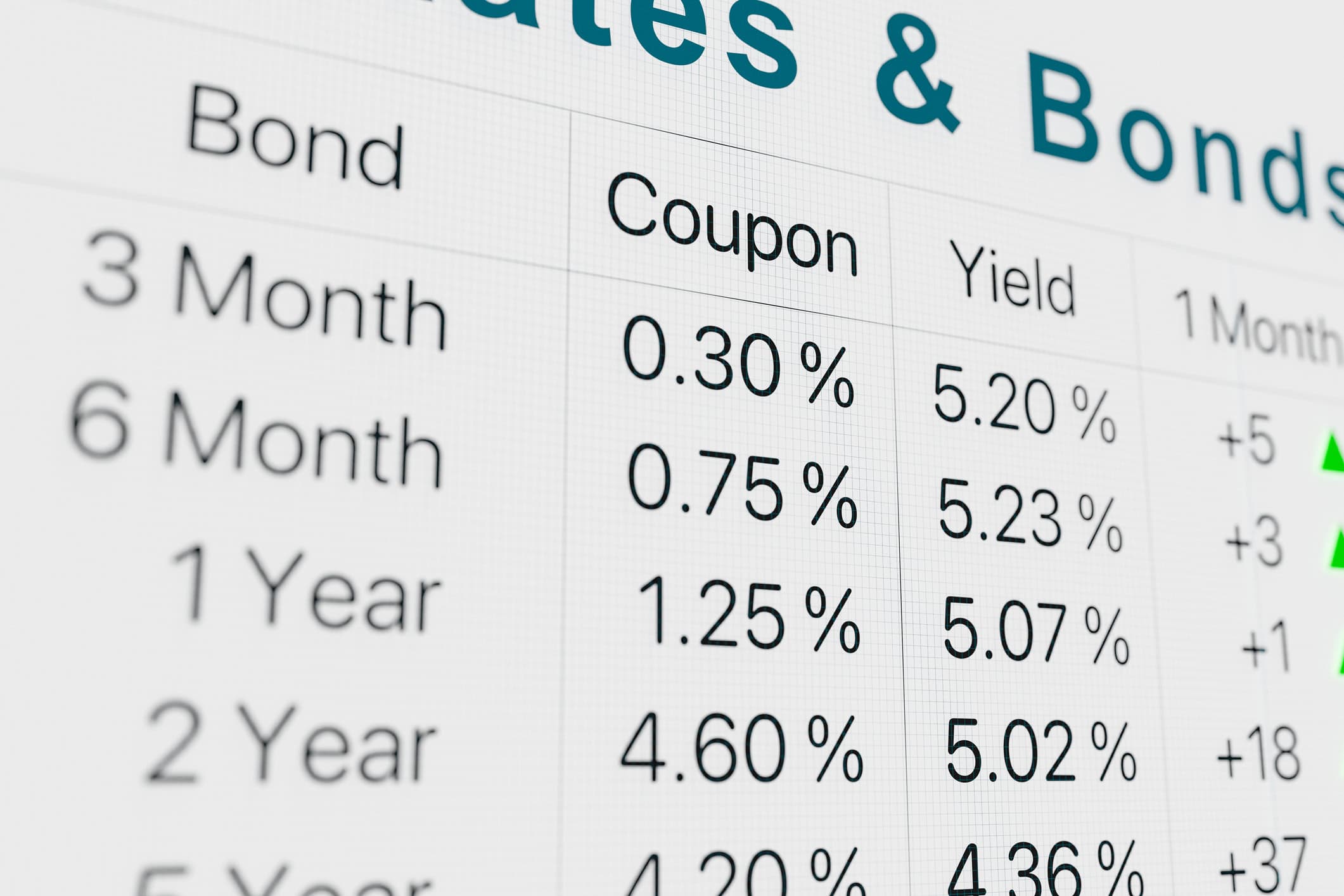
Coupon rate and yield are often confused, yet they are not the same. The coupon rate is the bond’s stated annual interest payment as a percentage of face value. Yield is the return an investor earns based on the bond’s current market price.
If a bond with a $1,000 face value pays a 4% coupon, it sends out $40 per year. If that bond trades at $900, the yield for a new buyer is higher than 4% because the investor gets the same $40 annual payment while paying less upfront.
Yield to maturity goes a step further. It estimates the total annualized return if the bond is held until maturity, assuming coupon payments are reinvested at the same rate. It includes coupon income, any premium or discount, and the time remaining until maturity.
That is why bond prices and yields move in opposite directions.
A bond trading above face value has a lower yield than its coupon rate. A bond trading below face value has a higher yield than its coupon rate. This is not a quirk. It is the market’s way of adjusting old cash flows to new return requirements.
Why lower-coupon bonds often move more than higher-coupon bonds
Coupon size matters because it affects how quickly investors receive cash. A higher-coupon bond returns more money earlier through larger periodic payments. Those earlier cash flows are less sensitive to shifts in discount rates than cash flows far in the future.
Lower-coupon bonds, by contrast, leave more of their value tied to the final payment at maturity. That pushes their duration higher, which tends to increase price swings when rates change.
Zero-coupon bonds make the pattern especially clear. They pay no interim interest at all. Every dollar arrives at maturity, so their prices tend to react sharply to changes in rates.
This is one reason two bonds with the same maturity can still behave differently. Coupon structure matters, not just the calendar.
What rising interest rates mean for bond investors
Rising rates can be frustrating in the short run because existing bond prices fall. Investors see losses on statements and may wonder why a “safer” asset class is moving the wrong way.
Yet higher rates also create opportunity. New bonds come to market with better yields. Coupon payments and maturing principal can be reinvested at more attractive rates. Over time, that higher income can help offset earlier price declines, especially for investors with patience and a defined holding period.
This distinction matters: short-term market value and long-term income are not the same thing.
An investor who plans to sell a bond next month may care deeply about price volatility. An investor who intends to hold to maturity may care more about issuer quality and the cash flow schedule than about temporary price moves.
How falling interest rates change the bond market
When rates decline, bond prices usually rise. That can create strong total returns, especially for long-duration bonds and bond funds. It is one reason bonds can act as a useful counterweight when economic growth slows and central banks cut rates.
Still, falling rates bring a tradeoff. While existing holdings may appreciate, the income available on newly purchased bonds tends to drop. Reinvestment becomes less attractive, and future returns may be lower than recent gains suggest.
Bond investors often enjoy the price boost from falling rates, but they also face a leaner yield environment afterward.
Interest rate risk in bond funds versus individual bonds
Interest rate risk shows up differently depending on how you invest. An individual bond held to maturity has a known end date and face value, assuming no default. If rates rise in the meantime, the market price may drop, but that decline may not matter much if the bond is held until it matures.
A bond fund works differently. It does not mature on a single date, illustrating how interest rates impact bond prices as the manager continuously buys and sells bonds. The manager usually buys and sells bonds continuously, so the fund’s net asset value reflects current market prices at all times. That means rate moves are more visible and ongoing.
Neither structure is automatically better. They serve different goals.
A useful way to frame the choice is this:
- Individual bonds: predictable maturity date, known face value, direct cash flow schedule
- Bond funds: broad diversification, easy access, ongoing exposure to market pricing
- Short-duration funds: lower rate sensitivity, lower yield potential
- Long-duration funds: higher rate sensitivity, higher upside when yields fall
The best fit depends on time horizon, income needs, and tolerance for interim price movement.
Practical ways to respond to interest rate changes in a bond portfolio
Trying to guess every rate move is rarely a durable strategy. A steadier approach is to build a portfolio that can function across different environments.
That often means matching bond exposure to the investor’s time frame, especially considering inflation’s impact on purchasing power over time. Shorter maturities can reduce volatility. A laddered bond portfolio can spread reinvestment dates over time. Mixing Treasuries, investment-grade corporates, and other sectors can also shape interest rate risk and income in a more controlled way.
A few practical habits can help keep rate changes in perspective:
- Match duration to your timeline: If money is needed in the near future, shorter duration usually makes more sense.
- Use reinvestment to your advantage: Rising rates can improve future income when coupons and maturities are rolled into higher yields.
- Look at total return, not just price: Income matters, especially over multi-year periods.
- Know the difference between rate risk and credit risk: A bond can fall because yields rise even when the issuer remains financially sound.
For many investors, the most useful shift is mental. Instead of asking whether rate moves are “good” or “bad” for bonds, it is better to ask which bonds, over what time period, and for what purpose. That question leads to clearer decisions and a stronger bond strategy.
Disclosures:
This commentary is not a recommendation to buy or sell a specific security. The content is not intended to be legal, tax or financial advice. Please consult a legal, tax or financial professional for information specific to your individual situation. Investing involves risk, including possible loss of principal. Past performance is no guarantee of future results. Diversification does not guarantee a profit or protect against loss. The interest on municipal bonds, unless identified as “taxable” or “AMT” (alternative minimum tax), is exempt from federal income tax, but may be subject to local or state income tax for residents of certain states.